
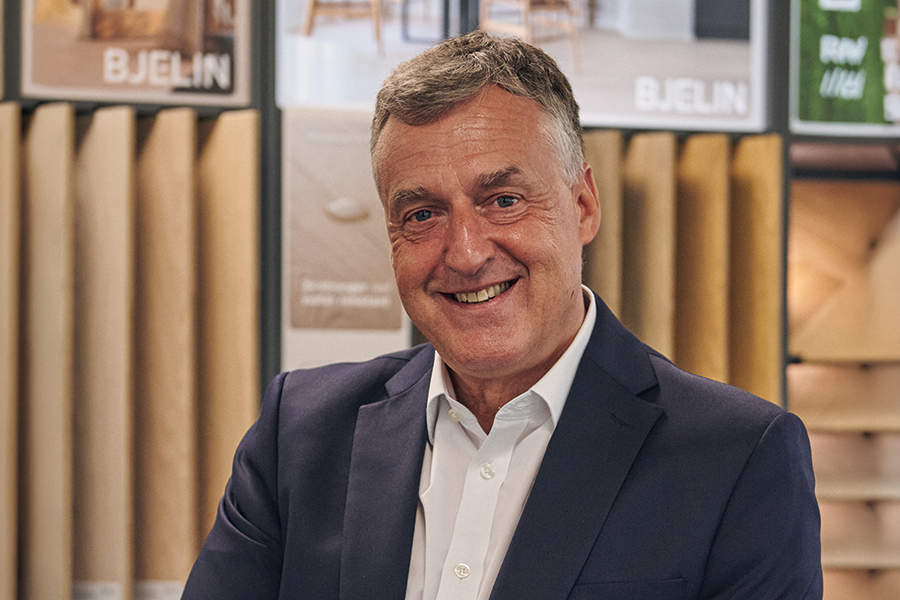

Recently, hardened wood flooring manufacturer Bjelin celebrated its 10th anniversary. For this month’s interview, we spoke with Bjelin UK’s Managing Director, Simon Darbyshire, about the company’s history, how it sets itself apart in the market and how it is navigating the many challenges facing flooring businesses today.
Q: Can you tell us a bit about Bjelin? How did it get started and what do you do?
Our origins are closely tied to our sister company, Välinge Innovation. Välinge itself was founded in 1993 by Darko Pervan, the inventor of click flooring, so we’ve been at the forefront of developing new flooring technologies since 1993.
Bjelin itself was established in 2016 and was born out of a vision to create high-quality, sustainable and innovative flooring products. The company has access to the Spačva Forest in Croatia, which is Europe’s largest continuous oak forest, allowing us to source reliable volumes of high-quality oak, whilst ensuring all the material we use is FSC-certified and sustainably managed.
We firstly created a patented technology called Woodura. In our unique process veneers are sliced rather than sawn which not only reduces waste it also allows us to use a tenth of the veneers usually associated with the production of engineered wood flooring. Secondly, we fuse the veneer to a water-resistant core through a high-pressure pressing process that incorporates wood powder sourced from manufacturing waste. This process creates a floor that is 100% wood, around three-and-a-half times more impact-resistant than a normal engineered wood floor, highly resistant to dents and gives a 72-hour water resistance.
All our manufacturing is done in-house, is sourced in Europe and we control the entire production process from forest to floor. All design is done in Sweden with production done both in Sweden and our new mega factory in Croatia, this being close to the Spačva Forest. This allows us to also cut down transportation of raw material as we take the logs straight from the forest, process them in our own veneer plant and then moving them to the manufacturing plants.
Q: What makes you stand out in the market?
The patented Woodura technology is what makes us different, plus the ability to use other patented technologies from our sister company Välinge Innovation, such as 5G Dry locking technology, which means our floors offer an easy, glue free floating installation, whilst providing a leakproof locking solution. This stops liquids from reaching the subfloor.
It gives us a real point of difference from traditional engineered wood flooring.
When we first entered the UK market, the architect and specification sector was the first to really get to grips with the benefits of our technology. We quickly established ourselves with Domus Group, a highly respected supplier with over 50 years’ experience in the sector and built our reputation on the commercial side first.
Domus were kind enough to publicly state that the launch of our products had been the most successful flooring product launch they had done in the past decade.
From there we have developed into the retail sector with a number of distributors, and we’re continuing to do that now. Our latest development is the rollout of a national distribution network, which means we’re now able to also be more consumer-facing as well.
Q: What are the biggest lessons you’ve learned in 10 years of Bjelin?
One of the biggest lessons we’ve learned is that the technology is suited to many different international markets. We started in Sweden, Norway and the other Scandinavian countries, where we became market leaders, but we’ve since built a strong international presence.
This success has confirmed our belief in the technology and means we are continuing to focus on veneer and our resource efficient Woodura products, and that both the commercial and residential sectors have a real appetite for our products.
From a UK perspective, the biggest lesson has been education.
The UK market is very conservative with a small ‘c’. It likes what it knows and doesn’t necessarily like to change. In Scandinavia it’s much more of a wood-based marketplace. People are more used to having wood in many rooms of the house and are more familiar with the benefits of timber products.
Once people understand the technology, and they do get it very quickly, we see repeat business as a result, with customers buying into the many benefits of the product offer.
Q: What have been the major developments in the wood market over that period and more recently?
LVT has been one of the biggest developments. The continued growth of LVT is one of the things we’ve seen over that period, and it’s really taken over from laminate. LVT is definitely our biggest competitor, even more than carpets in the UK.
Another major development is that people are becoming less interested in taking a cheaper product from the Far East and are becoming more interested in quality products that differentiate from the norm, but are still commercially competitive. They’re also more interested in the sustainability aspect as well. People are more willing to listen than they perhaps were in the past.
The other thing we’ve seen is people wanting to source closer to home. World events over the last 10 years have caused issues with sourcing, not just from the Far East but also from places such as Ukraine and other areas where a lot of wood flooring traditionally came from.
There have been changes in sourcing habits and in people’s growing requirement for a quick, reliable and consistent delivery.
Q: What are customers looking for at the moment in terms of design and functionality?
From a design point of view, we’re seeing a lot of demand for what we call select grade, a clean straight grain look, Select grade has been very popular for us in the UK.
Historically, select grade has carried a significant additional cost compared with other grades, but because of the way the trees grow in the Spačva Forest, very tall and very straight, we’re able to source a lot of select-grade material and be very competitive. Our offer has always been very strong in that area. Even our Nature grade is very clean in comparison to the traditional rustic board previously favoured in the UK.
Colour-wise, we’re seeing designs starting to go darker again. The traditional Scandinavian colours, powder white, misty white and these shades are still popular, but the design community is starting to look at darker colours again. Decors such as our Terra Brown shade and Walnut décor are becoming more popular, and we’re beginning to see that filter through into retail as well as the commercial sector.
When it comes to board sizes, longer and wider boards are very popular. We started with our XXL plank, (271 x 2378 x 11mm) but our biggest-selling panel in the UK today is what we call XL, (206 x 2200 x 11mm). That size seems to have found a very good home across a lot of different sectors with us recently also adding a Modern herringbone board in larger format (91 x 546 x 11mm) to our collection.
From a functionality point of view, we use a 5G Dry lock from our sister company, Välinge Innovation, and our floors are designed as floating floors. That means they’re very quick to install, but it also means you don’t need glue. That removes adhesives and additional chemicals from the installation process, and if tastes change, the floor can be easily lifted and replaced.
The powder we use as part of the Woodura technology ensures the material can be recycled, added back into the powder and reused in the production process.
Our material is also suitable for underfloor heating, both water and electric systems, up to 27°C, so there are no issues there.
Q: What impact are wider economic pressures having on the market?
From our side, we haven’t really seen a large impact from what’s happening in global economics with regard to the supply chain as we’re producing in Sweden and Croatia and sourcing our raw materials from those areas. We also don’t rely on a lot of chemicals within our production process.
I think some other sectors have been affected more significantly by global events.
The tariffs introduced in America and then in Europe have certainly had an impact on availability and cost and have encouraged people to look at sourcing from different countries than previous, people are becoming much more interested in lead times and sourcing closer to home.
We use one of the largest international haulage companies, for most of our distribution into the UK, and we have an agreement of 10 working days from dispatch to delivery.
The challenges are undoubtedly there for both consumers and the construction sector, but at the moment they’re affecting some sectors more than others. The wider economic pressures are obviously never good for any of us because of the impact they have on people’s confidence and ability to spend, but currently we’re not seeing the same level of disruption that some other sectors are experiencing.
Q: What are the biggest challenges facing the market and how are you handling them?
The biggest challenges are currently economic and the availability of raw material.
If you look at GDP figures, international uncertainty and the various issues happening around the world, they all affect consumer confidence. When people have less money in their pockets, they naturally become more cautious about spending and want to ensure that when they make a purchase it is the correct one.
That’s something that concerns everybody in the industry.
The commercial marketplace itself is still reasonably strong. The latest figures I’ve seen showed that the construction industry grew in the last quarter, and we’re seeing an increase in activity from the commercial side this year v YTD 2025. Retail is less strong but still brings opportunity.
As a company in the last year we have experienced a 40% increase in Woodura flooring growth internationally, which confirms our strategic direction and the market demand for durable, resource efficient flooring solutions.
If we’re talking about products and materials specifically, then one of the challenges is veneer and log supply including log quality. There is a genuine shortage of veneer in the world market compared with where things were previously, with people now understanding that a thick wear layer does not automatically mean a better floor.
For us, veneer remains a very important part of the future. Because we use significantly less raw material than many traditional products, we see that challenge as an opportunity as well.
Q: Is sustainability a focus for Bjelin and for your customers?
Yes, absolutely.
Being a Swedish company, sustainability is very much part of who we are. Whether it’s FSC certification, Nordic Swan certification, ISO standards or our Environmental Product Declarations, sustainability is built into the business.
We have significant documentation covering our products, what goes into them and how they’re manufactured.
On the commercial side, customers are very aware of sustainability. That’s one of the reasons architects and designers responded so positively to our products when we first entered the UK market and continue to do so.
We’re starting to see consumers becoming more aware as well, although I still think consumers are largely driven by cost. Everybody likes the idea of sustainability, but cost also plays a part, however, slowly but surely people are starting to shop in the way that they’re talking.
Q: What is your core message to the market?
We’re still relatively new players in the UK market, but we’ve proved over the last 10 years as a company that this is a product and a business model that can grow internationally.
Our core message is that we’re continuing to grow in both the commercial and residential sectors.
We’re now seeing other manufacturers bringing 0.6mm veneer products into the market, which tells us we’re going the right way and doing the right thing. Competition is sometimes a compliment.
We believe that with the patented technologies we’ve created, we’re ahead of that curve and that we’ll remain ahead of it.
As Bjelin International our focus remains on scaling Woodura production, with veneer allowing us to take control of our own development. It allows us to better use and protect raw material resources, whilst also reducing our reliance on what can be fluctuating log quality. We see ongoing investment in thin veneers and veneer production combined with Woodura technology as the direction of travel for our business.
We also see wood coming back into fashion. As strong as LVT is, we’re seeing more and more people wanting the genuine warmth, feel and authenticity of a real wood floor.
Our core message for the UK market is that we see the sector growing. We see a major opportunity to continue developing our market share, and we’re looking forward to growing alongside the right national partners.
www.bjelin.com