
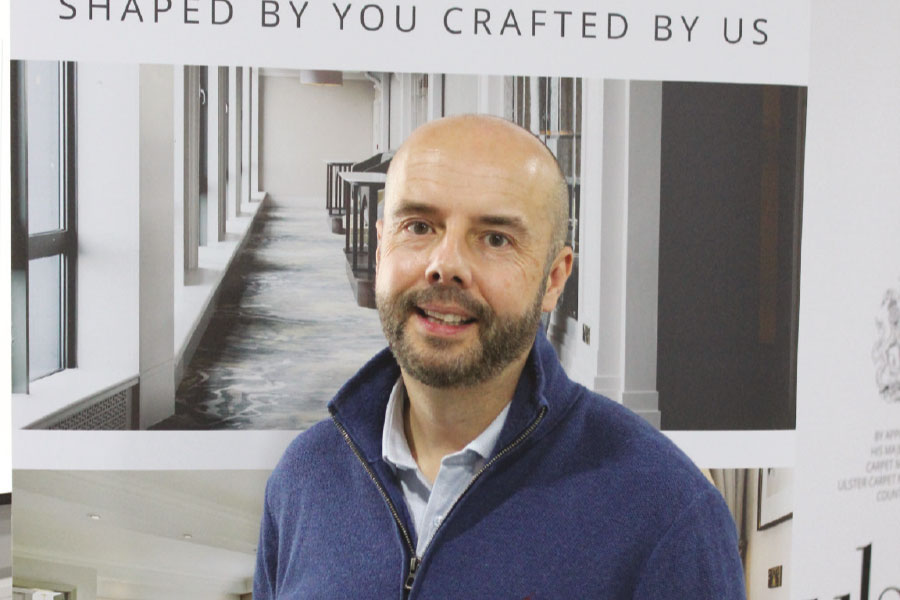

Founded in 1938, Ulster Carpets is a family-owned company based in Northern Ireland, describing itself as the “largest single-site producer of Axminster and Wilton carpet in the world”. This month, we spoke with Andrew Gicquel, Residential Sales Manager at Ulster Carpets, about the company’s history, its products, and how it’s approaching 2026.
Ulster Carpets was initially established by George Walter Wilson in County Armagh, remaining one of the area’s largest employers to this day. Focusing purely on residential sales for the first 60 years of its existence, the company diversified into contract work around 20 years ago, supplying flooring for casinos, hospitality venues and cruise ships. While this segment of the company’s business has grown steadily over the intervening years, the retail market remains a strong focus.
One of Ulster’s strengths is that it controls “all parts of the manufacturing process,” Andrew tells The Stocklists. After sourcing its wool, the company sends the raw material to its spinning plant, before dyeing the yarn and then weaving it in-house. “That gives us the ability to control standards and quality throughout the entire manufacturing process,” Andrew says. The company focuses primarily on woven Axminster and Wilton carpets, combining creative designs with its proprietary PSYLO weaving technology.
While much of the market has moved to synthetics, the majority of Ulster’s products remain either 100% wool or an 80/20 blend, with the raw material sourced from Britain, Ireland and New Zealand. “It’s a miracle fibre,” says Andrew. “It’s natural and renewable and there’s a good story there.” But if its product composition hasn’t changed, Ulster’s designs have required a more agile approach. Like the rest of the industry, the company had to react “really quite quickly” when consumer sentiment sharply turned against the greys that dominated the market in previous years. The Open Spaces range has seen 10 new colours added in soft greens and golds, as well as warmer naturals, and the company is following up this year with a new 100% undyed range as part of its Natural Choice collection.
Beyond the main Ulster Carpets brand, however, the larger group encompasses several other businesses which bolster its versatility and overall offering. These companies include Danfloor, Axfelt, Alternative Flooring and Roger Oates Design. Filling in product segments Ulster itself doesn’t cater for, these companies supply synthetic carpets, underlay, as well as runners and rugs.
In addition to the value these companies produce in their own right, their products and expertise are synergistic throughout the group. For example, all of Ulster’s loop pile ranges are now produced by Danfloor in Denmark, and the addition of Axfelt has also boosted its retail offering with complementary underlay products. “It’s now quite diverse,” says Andrew, “but there’s good synergy between all those businesses and the overall Ulster group.”
Market outlook
“Last year was slightly challenging,” Andrew admits, echoing a common refrain in the carpet industry. While difficult market conditions obviously impacted performance, Ulster also made several large investments which, while necessary to facilitate future growth, entailed significant upfront cost. For example, it built a new weaving building with eight high speed looms. “That’s been a big cost to the business, but it was an investment we really needed to build up our Axminster capacity,” Andrew says.
The company also switched to a new IT system, which wasn’t without its own teething issues, Andrew admits, though he says this too was a necessary step to improve efficiency: “Apologies to any retailers we may have let down over the last year, but we’re getting there now and 2026 should be much better!”
In line with recent trends, smooth flooring saw consistent growth throughout last year. There’s no denying that the carpet market struggled, however, with historic brands like Adam Carpets entering administration. “The demise of a competitor of ours was really sad to see.” Indeed, Andrew can see the old Adam Carpets factory from the window of his office in Kidderminster, so the company’s closure hit particularly really close to home.
For Ulster, this loss demonstrated the precarious position of carpet as a category, with fierce competition from increasingly popular smooth flooring options like LVT. “A big challenge for us and other pure carpet manufacturers is to fly the flag for carpets and talk about the benefits, whether that’s acoustics or insulation or just the warm, cosy feeling a carpet can offer.”
Between widespread consumer anxiety and growing competition though, business continues to become more and more challenging. Andrew points to some of The Government’s economic policies (such as the changes to National Insurance contributions) as exacerbating factors, making it even harder for businesses to stay healthy.
Despite these stormy conditions, there are still reasons to be optimistic. In particular, Andrew points to the resilience of independent retailers as a saving grace for the carpet industry. “I think we’re quite lucky that the carpet and flooring trade is dominated predominantly by independent retailers. It shows the historic success of smaller independent businesses that are really focused on customer service and reputation.”
Changing with the times
Of course, for Ulster, it’s crucial to keep up with what customers are looking for. Since the pandemic, for example, preferences around retail have changed significantly, with customers more likely to research online before making a trip to a physical location. “I think technology and social media has become a lot more important for the trade,” says Andrew. “You see retailers and manufacturers with really nice websites, trying to make the customer journey more relevant to how people are shopping nowadays.”
Recognising that consumer shift, Ulster has redesigned its own website, which is set to go live in Spring of this year. One of the big additions to the new site will be a room visualiser, which will allow consumers to take a photo of their own room and choose different designs to trial on the floor. “Certainly, for our pattern consumer, I think that will really help,” says Andrew. “Especially if they haven’t seen the pattern before or it’s a product they hadn’t considered.”
Still, like many in the trade, Andrew maintains that there will always be a meaningful place for physical retail in the carpet sector. “I know there are companies that have tried and are still trying to do so, but it’s quite a hard product to sell purely online – it’s a very touchy-feely purchase. And I think carpet and flooring shops can be inspiring when a customer walks in and sees colour and texture and imagery. If consumers make that choice to go instore, retailers should embrace that, as it allows them to tell the story of that product better.”
And even where customers are moving away from carpet towards smooth flooring options, Ulster is adapting to make sure it has supplemental offerings, like stair runners or rugs, where carpet can offer a splash of colour or a touch of comfort. “I think there is a place for carpets in these areas, but we’ve got to make it interesting and exciting for consumers.”
Naturally, the biggest trend in consumer preference over the past several years is the massively increased scrutiny on sustainability. While it’s more obvious and in some cases mandated in the commercial market, demand for sustainable products is increasing in the retail sector too. “We get emails from consumers every week asking about chemical treatments and sustainability, where our wool is from – it’s a massive focus for us as a group. We’ve got a full sustainability model that runs throughout the entire Ulster group.”
Even now, with financial pressures making sustainability less of a top priority for many consumers, Ulster is keen to maintain high standards across the group. “We think there will be a growing demand for sustainability moving forward. There are parts of the manufacturing process that are energy intensive, so minimising that is obviously great for our environmental impact,” Andrew says. “It’s also great for us as a business, bringing down energy costs.”
Interestingly, Andrew notes, over the past several years the average age of Ulster customers has come down. Where previously it would mainly cater to the over-50 market, the addition of plain Wilton and loop offerings have now drawn a slightly younger consumer base to the brand. Although the products are still on the premium end of the market, Andrew assures that the company’s pricing is “fair and representative,” and that younger buyers have responded well to both the quality and longevity of Ulster’s ranges. “They also consider the fact that it will last and still look good in a number of years, which appeals from a sustainability perspective – if you’re ripping something up every five years and it’s going to landfill, that’s not a great story,” he points out.
Pushing forward
Given the longstanding history and tradition of carpet manufacturing in the UK, it’s easy to imagine the processes have remained much the same since the 18th century, but Andrew says the pursuit of progress at Ulster is relentless. “We’ve always prided ourselves on our technological innovations to keep us ahead of the pack.”
One example of this innovation is the company’s regular upgrades to its proprietary PSYLO (pre-selected yarn loading operation) technology, which the company says offers “extraordinary, new opportunities for design not available with any other carpet weaving system.” Ulster says the technology enables carpet to be manufactured to a greater degree of design intricacy, with an enhanced spectrum of colour and increased efficiency. It has also allowed the company to keep its manufacturing in Northern Ireland, guaranteeing continuity of quality and service.
This year, the company is focusing on the aforementioned new weaving building and website update. Andrew explains that demand for Axminster carpet grew rapidly post-COVID, and the company’s new capacity will help it take advantage of continued buoyancy in the segment. In addition to the increased capacity, the finish of the carpet is also superior on these new looms. So, while 2025 was perhaps a slower year than Ulster might have hoped, its investment during this period has allowed the company to position itself to take advantage of existing opportunities in the market as well as any recovery the carpet trade may experience throughout 2026.
FOR MORE INFORMATION:
www.ulstercarpets.com