
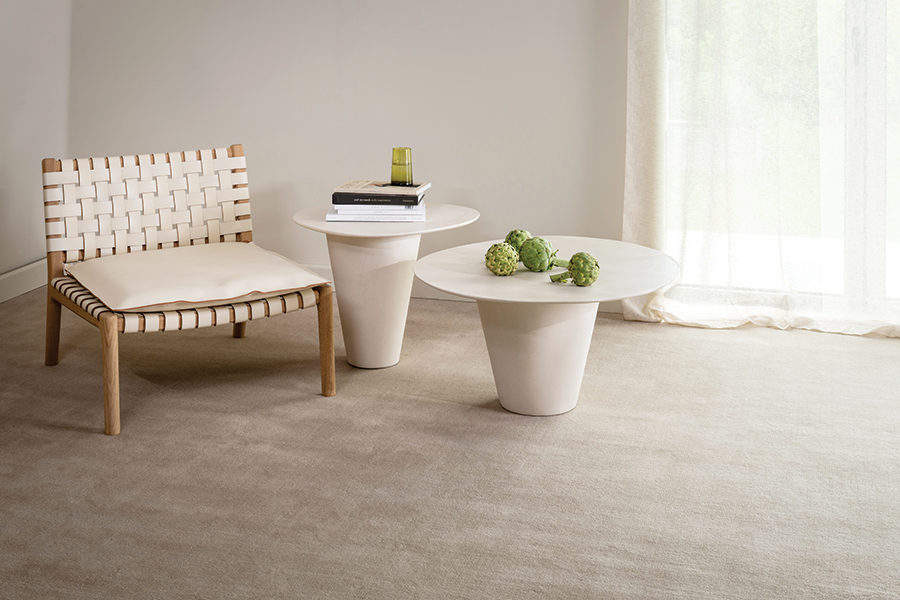

Artisan Luxury Flooring entered the market just three years ago, with its three founders bringing a modest selection of products to The Flooring Show in Harrogate. From those humble beginnings, the company has quickly built a reputation as a top UK supplier of high-end carpets. This month, we spoke with Co-Founder and Managing Director, Julian Downes, about how Artisan has successfully established itself within the market during a period of significant volatility.
The first factor behind Artisan’s rapid momentum is the combined knowledge and industry connections of its founders. Julian partnered with Raymond van Dijk and Klaas Bakker, who together run a European business called Fame Flooring, having worked with both previously. There really is no substitute for experience, as the saying goes, and the collective experience between its three co-founders meant that Artisan launched with a strong understanding of sourcing, market trends and how to run a successful flooring business.
This advantage was first demonstrated by the specificity with which Artisan targeted its chosen market segment. “Raymond was the first person I worked with in terms of sourcing products,” Julian explains. “Play the tape forward 15 years, and we saw a gap in the market for an additional high-end luxury flooring brand.” While Artisan’s initial range was synthetic in origin, the brand elevated its positioning through superior nylon and polyester fibres, complemented by a refined soft-touch finish ensuring the ranges felt and looked up to par with any of their competitors.
The bet paid off, with the company’s original product range finding a warm reception at its first Harrogate Show. Moreover, the founders’ pre-existing relationships in the market meant that getting their products into shops was relatively simple. “Because we’d all worked in the market for a long time, we were fortunate enough to have very good relationships with a lot of the retailers already,” Julian says.
Since that time, the company has expanded its portfolio, introducing hand woven nylons Positano and Amalfi and, more recently, launching Eternity and Infinity designs in 100% New Zealand wool. The company is especially excited about these latter two, representing Artisan’s first foray into wool. “We recognised that we need to broaden the portfolio and offer sustainable and beautiful natural materials in addition to our other products.” Beyond their fibre, the ranges’ sustainability credentials are further bolstered by the fact they are hand-woven.
The choice to develop even higher-end products may seem like a counterintuitive one at this moment. After all, with production and transport costs soaring and consumer confidence plummeting, there is a compelling argument to focus on the more affordable end of the market, hoping higher volumes will offset lower margins. If you weren’t already clued in by the company’s name, though, this is not an approach that appeals to Artisan.
“The whole position of Artisan is in the luxury flooring end of the market,” Julian explains. “That’s our customer base. We’re not interested in dealing with every single retailer in the UK – we’re very selective with who we work with. At the top end of the market, there are only so many people you can talk with, but that’s where we feel the most comfortable, that’s where we continue to evolve and develop.”
More broadly, Artisan believes continued investment into new products and maintaining market presence is the best way to thrive in a difficult market.
Bracing for change
It certainly is a difficult market though, Julian admits, particularly for companies like Artisan that rely on petrochemicals for their synthetic products. As has been widely reported at this point, the eruption of further conflict in the Middle East has caused oil prices to rise drastically, wreaking havoc on the flooring supply chain. “The price of oil obviously has a big bearing on our business,” Julian says, “but we try to tackle those problems head on.”
He explains that Artisan can mitigate some of the price increases thanks to its close relationships with the factories where its products are manufactured. While there are clearly no easy answers, by buying its yarns in bulk, the company has thus far managed to keep its price increases down to “once a twice a year,” rather than every month. “And that affords our customers the space and the ability to plan things a little better. I hear a lot of frustration from retailers when they’re hit with price increase after price increase.”
As with product development, Artisan’s philosophy here is to invest in its customer offering, rather than try and minimise its own costs. “It requires a lot of planning, a lot of stock holding and working proactively rather than just reactively.”
Julian is keen to point out that inflationary pressure extends far beyond oil. Wool prices have also increased sharply, while the cost of everything from cardboard poles and plastic wrapping to wages has risen over the past few years. In his view, there is little value in pretending the industry can absorb those increases indefinitely. The more important question is how suppliers respond. Rather than chasing the lowest possible price, Artisan believes retailers and consumers alike are increasingly looking for products that justify their cost through quality, longevity and design.
“I don’t think there’s really such a thing as a cheap carpet anymore,” he says. “When you add in the cost of fitting, underlay and everything else that goes with it, people stop and think about what they’re buying.” That, he argues, plays to Artisan’s strengths. Customers spending more on a flooring purchase naturally expect it to perform over many years, making durability just as important as appearance. “If people are going to make that purchase, then they want the product to be a good quality product.”
The personal touch that emphasis on long-term value is mirrored in the way Artisan approaches its retail partnerships. Julian repeatedly returns to the importance of relationships, describing them as one of the company’s greatest competitive advantages. Between the founders and Artisan’s sales team, many customer relationships stretch back 15 or even 20 years, with some now spanning multiple generations of family-run flooring retailers.
The company believes its independence also sets it apart in a market traditionally dominated by a few much larger suppliers. “The feedback we get from our customers is they really like the fact that we’re independent,” Julian says. “They can pick up the phone and talk to me, they can talk to Raymond, they can talk to Klaas. We’re always available.”
That accessibility goes hand in hand with a collaborative approach to product development. While Artisan works closely with its manufacturing partners on specifications, colours and construction, Julian says retailers themselves play an equally important role in shaping future collections. “They’re the people at the coal face,” he explains. “They’re the ones who know what customers are asking for. It’s important to listen.
That philosophy also explains why Artisan continues to commit heavily to exhibitions. While the role of trade shows has often been questioned since the pandemic, Julian remains convinced they are indispensable. Harrogate in particular provides an opportunity to meet independent retailers, gather feedback on new launches and discuss the pressures customers are facing. Events also provide an opportunity to showcase the company’s point-of-sale displays, an area where Artisan continues to invest heavily in supporting its retail partners.
A sustainable future
Although Artisan operates nationally, the business itself is based in Devon. Julian acknowledges the South West is not the most obvious location for a nationwide flooring distributor, but modern distribution networks mean geography presents few practical obstacles. Regular collections by logistics partners ensure products move around the country efficiently, allowing the company to combine a rural base with a national customer network. The location has also shaped Julian’s wider perspective on business. Living in the South West, he says, offers regular reminders that economic challenges are by no means confined to Britain’s traditional industrial regions. “There is real poverty,” he observes, arguing that stronger infrastructure and better transport links would benefit businesses and communities across the country. While he remains optimistic about the UK’s long-term prospects, he believes sustained investment will be needed to unlock that potential.
The same pragmatic outlook informs Artisan’s approach to sustainability. Julian is careful to avoid overstating the company’s environmental credentials, acknowledging that the flooring industry has sometimes suffered from exaggerated marketing claims. “It’s important to be sincere and honest,” he says.
Instead of making sweeping promises, Artisan has focused on practical improvements. Its main warehouse operates using solar power, company vehicles are gradually being replaced with electric and hybrid models, while recycling of packaging materials and operational waste is now close to complete. The company’s newest wool collections also reflect a broader shift towards natural materials, with hand-woven production requiring no electricity during manufacture.
For Artisan, however, sustainability remains just one part of a much broader ambition. Having entered the market with just three products, the company now sees itself as a long-term player intent on steadily expanding its range while remaining true to the premium positioning that defined its launch. As Julian puts it, Artisan may have started modestly, but it remains “an ambitious, forward-looking company” looking to redefine luxury flooring in the UK alongside the retailers who have supported its growth from the beginning.
www.artisanluxuryflooring.co.uk