

Unmanaged excess subfloor moisture is the leading cause of floor failure and frequently results in delays to projects, major inconvenience and expense when remedial work is required. Tim Green, Training Manager at the UK’s leading manufacturer of subfloor preparation products and adhesives for floorcoverings, F. Ball and Co, tells us why and how to manage subfloor moisture before installing LVTs.
Unchecked subfloor moisture, whether residual construction moisture or rising damp, can attack flooring adhesives and floorcoverings, causing resilient floorcoverings, such as vinyl and LVTs, to blister and lift. Not only can this ruin the finished appearance of a flooring installation, but it can result in complete floor failure and present a health hazard.
F. Ball’s technical service department frequently receives enquiries from contractors who have been called to rectify a recent flooring installation where floorcoverings have begun to lift as a result of unmanaged excess subfloor moisture, and our regional technical representatives often attend site visits where this is the case.
Given customers’ high expectations for LVT installations, it is therefore important to take time to determine subfloor moisture levels and deploy an appropriate moisture management solution, where necessary, prior to installing them.
Testing
In addition to ensuring a subfloor is suitably sound, smooth and free of any contaminants, including any old adhesive residues, it is essential to undertake a moisture test to check for subfloor moisture to determine if the subfloor is dry enough to receive a floorcovering.
The only way of measuring subfloor relative humidity levels with accuracy, and the method advocated by British Standards, is using a calibrated digital hygrometer.
Normally, a liquid waterproof surface membrane will be required to suppress excess subfloor moisture and prevent damage to flooring when Relative Humidity (RH) levels are above 75%. However, the maximum permitted figure is 65% where wood floorcoverings will be installed because of the sensitivity of this type of floorcovering to moisture.
Solutions
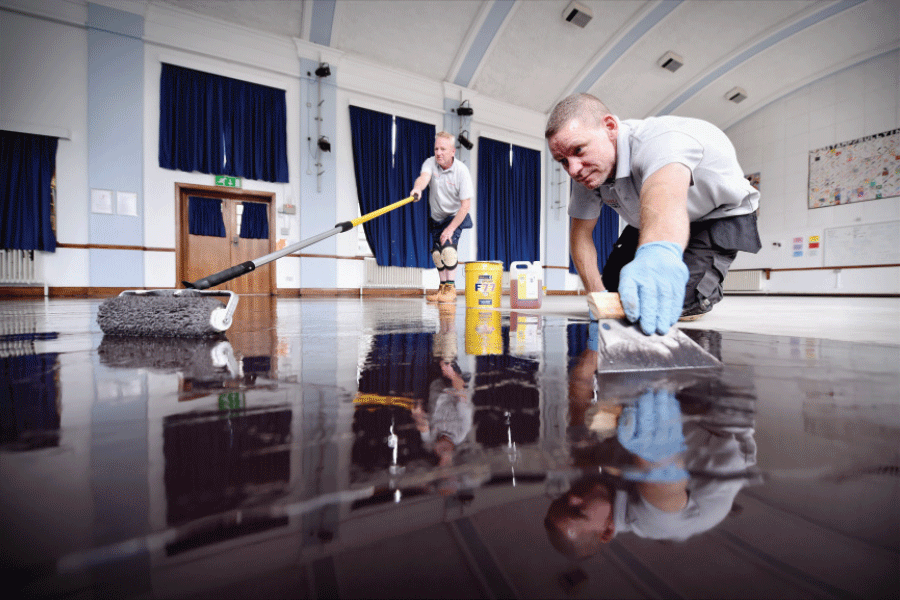
F. Ball has two timesaving options for when a moisture management solution is required. Stopgap F77 waterproof surface membrane is a two-part, epoxy resin system, which is applied in a single coat. It fully cures in as little as three hours and will isolate residual construction moisture or rising damp where relative humidity values are up to 98%.
For an even quicker way to create a barrier against residual construction moisture where RH values are up to 95%, there is Stopgap F78, a one-component system, which is applied in two coats, requiring 15–20 minutes curing time for the first and a further 30 minutes for the second.
Next steps
After checking for subfloor moisture and deploying a moisture management solution where necessary, contractors can proceed with preparing the subfloor for the installation of new floorcoverings. This will usually include the application of a smoothing compound to create a perfectly smooth base for the receipt of floorcoverings, remembering to prime beforehand if necessary.
Finally, contractors can proceed to install floorcoverings using an appropriate adhesive once the smoothing compound has cured. Pressure sensitive adhesives are ideal for the installation of LVTs because they form an instant grab upon contact, so, once positioned, tiles or planks won’t move about as contractors work, a benefit when creating complex designs or patterns.
The compatibility of particular floorcoverings and adhesives should be checked to further ensure against floor failure. To do this, contractors can consult F. Ball’s Recommended Adhesives Guide (RAG), which lists adhesives recommended for use with over 6,000 floorcoverings produced by over 200 manufacturers. A continuously updated version of the RAG is available as a free app and on the F. Ball website. It is also available as an A5 printed booklet, free copies of which can be requested from F. Ball.
F Ball & Co • www.f-ball.com