
Founded in the late 1990s in Andover, Hampshire, Alternative Flooring was initially created to give the market a greater choice of plant fibre floorcoverings, such as sisal, seagrass, coir and jute.
Though the company has undergone many changes and developments since then, its focus in 2026 remains on the considered, discerning customer. This month, we spoke with Lorna Haigh, Creative Director at Alternative Flooring, getting her view on the state of the market, the challenges facing independent retailers and the importance of sticking to your values.
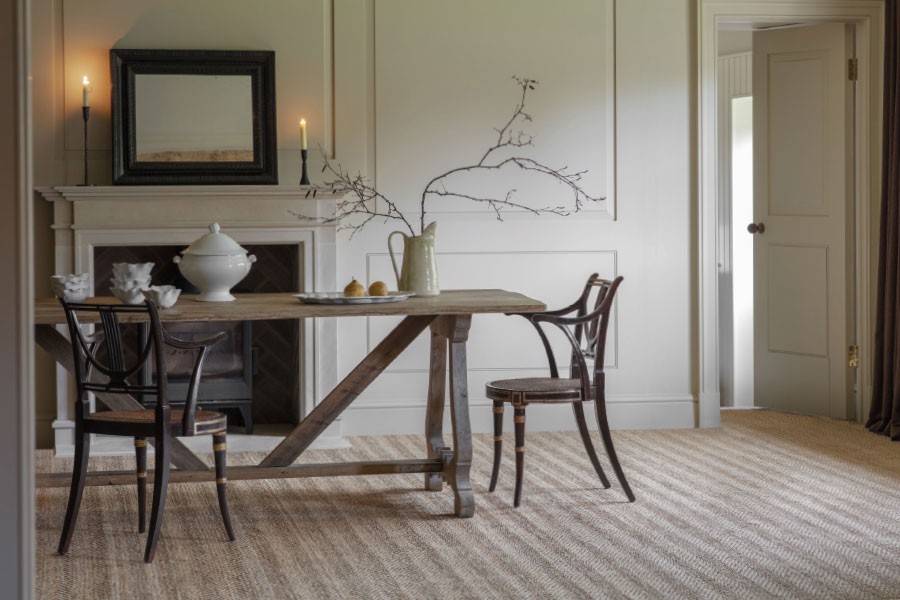
According to Lorna, Alternative Flooring’s philosophy centres around three main pillars: people, planet and product. “Every time one of our carpets or rugs is made, a person is involved in designing or making it. We want to do that in a sustainable, planet-orientated fashion, and then the end result of that is the product.” The company’s product range has evolved significantly over the past 25 years, expanding from its original plant fibre focus to include both wool and synthetic ranges, but across all of these collections, Alternative strives to make sure the human touch can still be felt.
“If you were to say what an Alternative product is,” Lorna explains, “we really talk about colour, pattern and texture. We’re not talking about a wool twist, we’re asking: has it got a bit of colour? Has it got texture? Is it the right texture and does it have pattern? So we’re always thinking about those things when we’re designing.”
Perhaps the most significant development in the company’s recent history has been its new ownership. In 2023, Alternative became a part of the Ulster Group (with whom The Stocklists spoke last month) remaining an independent and autonomous company but now with the expertise and resources of the larger group to support it. Following that acquisition, the company’s performance is up, says Lorna, bringing an impressive 10 new ranges to market last year. “Of course, 10 ranges is a huge amount for any company, and all of them have their own stories.” Although there’s no unifying theme connecting the new products, they are all design-led. For example, the new Wool Candy range, features stripes in a variety of on-trend colours.
In 2026, Alternative aims to curate its product portfolio and focus on marketing, not just in the UK but around the world. In that pursuit too, the company stands out from the crowd, promoting its products direct to consumers via a social first media strategy. “We market to the consumer heavily and we’ve been doing it for a long time. That means the consumer comes into the independent retailer asking specifically for our products.”
As part of this strategy, the company exclusively sells through independent flooring retailers. Alternative recognised that reaching consumers costs money, Lorna explains, whether that’s through multiples or independent retailers. The company therefore made a “conscious decision” to market direct to consumers, encouraging potential buyers to visit their local retailers and ask specifically for Alternative’s products.
Old and new
Lorna describes social media as “hugely important” for Alternative, explaining that the company has been active on platforms like Instagram and Pinterest since 2012. On Pinterest, for example, the company has 7000 followers, and this drives significant traffic back to Alternative’s own site. The company’s marketing team also collaborates with influencers, recognising that this has become one of the most effective ways to reach consumers. “We’ve done some really great collaborations, with influencers, tv personalities and designers, with one of our most recent, reaching over 797,000 views. Not only was it valuable for reach and engagement but our most requested sample changed too.” Lorna explains.
While it embraces modernity in its marketing, though, Alternative also places a lot of value on traditional craft and skills, along with the people who have honed them. For example, many of the company’s products are hand loomed, eschewing some of the cost-efficiencies achieved with machine production in order to maintain the all-important human touch. “I think there’s beauty in imperfection,” says Lorna. “The fact that somebody spent the time to make something is a pretty wonderful thing.”
Of course, this also has ramifications for the way the company sells the carpets too. Where many other factories have proudly minimised the amount of human involvement in the manufacturing process as part of Industry 4.0 initiatives, Alternative believes that by focusing on the craft of carpetmaking, it can position its products as higher value. “People will pay the money if you can tell the story and show the craft behind it,” Lorna says.
There are some technological advancements the company is more optimistic about, though. Artificial intelligence, Lorna explains, is being explored in Alternative’s design process, as well as its social platforms, its SEO and digital strategy, though she is careful to note that the company’s use of AI is not about replacing the human element. “You’ve got to have a balance between using technology while bringing people into the process. It’s really important to have the authenticity.”
Narrowing the gap
Proactively reaching the customer, whether via social media or any other means, has always been vital, but never more so than right now, with UK consumer confidence declining and little prospect of a sea change on the horizon. “It’s been really tough for the independent retailer,” Lorna admits. “Obviously after COVID we had a bounce back and everyone thought we were out of the woods, but recently the consumer has not had much money in their pocket.”
In such a market, she says, it makes the most sense to target those consumers who are less affected by fluctuations in the economy. With that in mind, there is a challenge for retailers to educate the consumer about what high-quality products are and why they are worth their value. “The retailer has to educate the consumer, they have to explain that it’s worth spending on quality floors first, because it really does make a huge difference when you walk into the home.”
One of the challenges Lorna sees for retailers currently is, perhaps counterintuitively, the sheer amount of choice they offer customers. Combined with the aforementioned education gap, she says, this can easily lead to customers feeling overwhelmed and either making the wrong choice or no purchase at all. “I think it is important to get the right brands in your shop, staff have to know the product and be able to educate the consumer. For us as a company we have to make sure we’ve given the right information to the retailer so they can impart that knowledge.”
This is a particularly important task for Alternative, given that some of its key products are less common and therefore less well understood. “Take the plant fibre, for example, often fitters are frightened of it because you have to double stick it, and we suggest you acclimatise it beforehand.” Address these challenges, however, and you have a product that consumers love, Lorna says, and one they’re willing to pay extra for, in both material and fitting.
For these reasons, Alternative has invested heavily in creating inspirational point of sale tools, designed to help retailers both understand the products and tell their associated stories. With good availability of samples and room visualisers too, the company hopes to address buyers’ uncertainties and encourage informed purchases. “If the consumer can understand that when they put a product down, it’s going to be fit for purpose and look fantastic and bring them joy, that’s going to give them the confidence they need.”
Holding firm
While customers are still likely to seek out quality even when budgets are tight, whether they continue to prioritise factors like sustainability and ethical manufacturing – particularly where this contributes to a higher price tag – is a lot more uncertain. For Alternative though, Lorna explains, the desire to manufacture flooring in a sustainable way isn’t rooted in cynical commercialism but a genuine belief that it’s the right way to do business. From there, the company hopes that it will attract the right type of customers whose values guide their purchases even during difficult times.
“I think our customer is a considered customer, I think they’ll do the research into what they want,” Lorna says. “The messaging is really important. We don’t just say it, we really believe we have to be considered when it comes to the planet and that we have a duty of care.”
That careful consideration is evident in the fact that, while the company makes every effort to be sustainable, Alternative doesn’t overstate its green credentials. “We’re not 100%,” Lorna says. “We don’t just want to jump on the sustainable bandwagon, we just try to do our best.” Examples of that effort are seen in the company’s Anywhere Ca-rPET range, in which the fibre is made from 100% recycled plastic bottles, and its Echo Co-RE polyester carpet which is itself recyclable.
For 2026, the company is continuing to champion its People, Planet, Product philosophy by investing more in hand loomed products, but beyond that, it also aims to improve its offering to its independent retail partners. “We have to bring an exciting product to them which is easy to understand, we’ve got to make it easy for them to order, and we’ve got to support them.”
“We want to help retailers do well,” Lorna concludes. “If they do well, we do well – it’s really not rocket science!”
FOR MORE INFORMATION:
www.alternativeflooring.com